
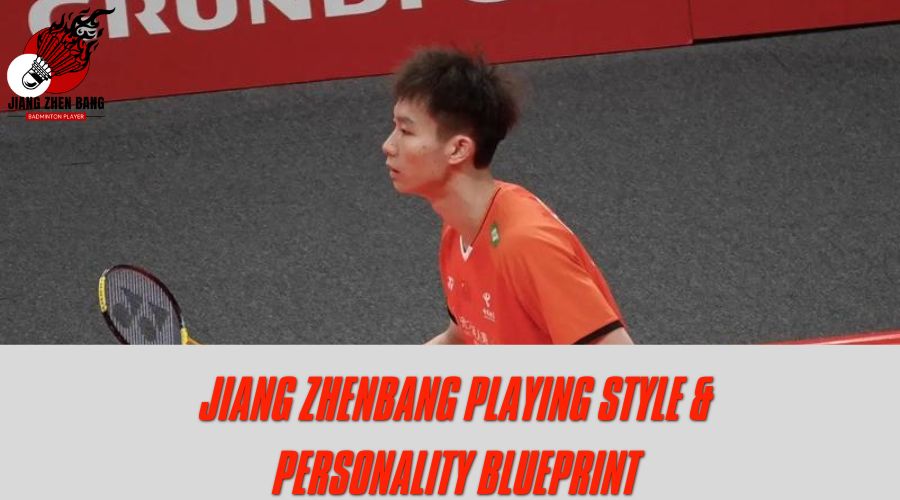
Understanding Jiang Zhenbang playing style requires more than watching highlights. It means reading the personality behind his choices: the calm, the discipline, and the architectural way he builds rallies. This profile decodes the psychology, the technique, and the training habits that turn composure into an elite mixed-doubles weapon.
The personality architecture behind the game
The most revealing lens on Jiang Zhenbang playing style is psychological. He is not a volume attacker chasing immediate winners; he is an organizer. The calm exterior, learned early through dorm-life discipline, translates into a style defined by clarity rather than adrenaline.
Composure as a competitive resource
When rallies stretch, Jiang gets sharper. His heartbeat of a point is steady pacing: probe, stress, expose, finish. This patience turns 50–50 exchanges into 60–40 edges over time.
Low-variance decision-making
His shot choices favor probabilities. If the window is not clean, he delays the strike and recycles the point with a neutral reset. This temperament reduces unforced errors and preserves energy across tournament weeks.
Core pillars of Jiang Zhenbang playing style
The modern mixed-doubles rear-court role demands power, angles, and sequencing. Jiang fits the mold but adds restraint and orchestration.
Tempo control
He toggles pace rather than blasting through it. Half-smashes and disguised drops are used to bend defensive shapes before unleashing the full smash.
Angle creation
Steep, shoulder-led attacks into lanes that force upward replies. Cross-drop to pull the net player off-line; then a body smash to punish the gap.
Rally sequencing
Points come in phases: establish width → test depth → break the line → finish. The sequence matters more than any single shot.
How the personality maps to technical choices
A composed athlete tends to prefer controllable mechanics. Jiang’s technique reads like a blueprint for repeatability.
| Personality trait | Technical expression | Tactical effect |
| Composure | Compact swing path; patient load-up | Clean contact under pressure |
| Discipline | Consistent split-step timing | Stable defense → faster counter |
| Clarity | Early preparation, quiet feet | More disguise on last instant |
| Trust (partner) | Crisp rotation exits | Frees front-court interceptions |
Communication, trust, and the mixed-doubles equation
In mixed doubles, psychology is shared. Jiang’s calm syncs with a front-court partner who thrives on anticipation.
Non-verbal cues
A glance signals the next rotation; a micro-nod confirms the tempo change. Minimal words, maximal alignment.
Space creation for the net player
He shapes rallies to give the net player first touch: lift forced to backhand corner, flat push to shoulder, or drop that invites a pounce.
Defensive structure and transition offense
Defense in elite pairs is a launchpad, not a pause button.
Stabilize → neutralize → weaponize
Block low to the body to slow the exchange, lift to a safe lane when spacing breaks, then counter with a quick two-shot pattern (tease the net, attack the seam).
Reading smash patterns
He anticipates body-line smashes and steers replies to the weaker mid-court defender, buying time for rotation reset and flipping position.
Serve, return, and first-three-shots philosophy
The first three shots write the rally’s script-especially in mixed doubles.
Serve philosophy
Tight, lower-risk serves that deny the opponent free net looks. Variations in depth are subtle but consistent enough to mask intent.
Return priorities
If the return cannot be offensive, Jiang prefers neutral height and awkward placement (hip/shoulder), which delays the opponent’s first organized attack and lets his partner step in.
Evolution timeline – from power to architecture
The silhouette of Jiang Zhenbang playing style has shifted from a raw power profile into an architectural one.
Early stage
More straight-line smashes, fewer disguises, reliance on athletic recovery.
Consolidation stage
Greater use of half-smashes, cross-drops, delayed acceleration. Neutral resets replace bailout lifts.
Present identity
Tempo-bending, angle-first design, and high-percentage finishing. The rally looks composed even when the pace is high.
Training habits that sustain the style
The style is only as reliable as the habits beneath it.
Micro-repetition for macro-control
Short blocks refining contact height and disguise windows. Ten perfect touches matter more than fifty rushed ones.
Footwork economy
Drills that bias efficient recovery over flamboyant chases. Quiet feet conserve energy and sharpen deception.
Scenario scrimmages
Start points from disadvantage: high defense, late rotation, or broken spacing. Win conditions emphasize rebuilds, not miracle winners.
Strengths, stress tests, and counters
No style is invulnerable. What stresses Jiang Zhenbang playing style-and how he answers it-reveals competitive maturity.
What stresses him
- Ultra-fast flat exchanges aimed at the right hip
- Early net poaches that deny his sequencing time
- Pairs that vary shuttle height to disrupt timing
His counters
- Use of body-line half-smash to slow hands and re-shape the point
- Earlier cross-drop to move the net player off intercept lanes
- Deeper neutral lifts that buy a full rotation cycle before re-attacking
The partnership multiplier
His blueprint scales with the right partner: front-court courage plus rear-court architecture.
Why the style lifts a partner
Because he sequences pressure rather than spamming power, the front-court player sees cleaner reads and higher-value interceptions.
Why the partner lifts the style
Reliable net threats force weaker replies, which accelerates Jiang’s finishing windows and reduces energy expenditure across matches.
What fans should watch for on the next big stage
If you want to read Jiang Zhenbang playing style in real time, focus on three tells:
- the moment he shifts from probe to strike,
- the angle that pulls the net off the tape,
- the reset that looks passive but is actually a springboard.
Some players burn hot; Jiang burns steady. The personality that shaped Jiang Zhenbang playing style-calm, disciplined, architectural-gives him a low-variance path to excellence across long seasons and high tiers. It is a style that ages well: less about chasing highlight winners, more about designing high-percentage rallies, one composed phase at a time.
