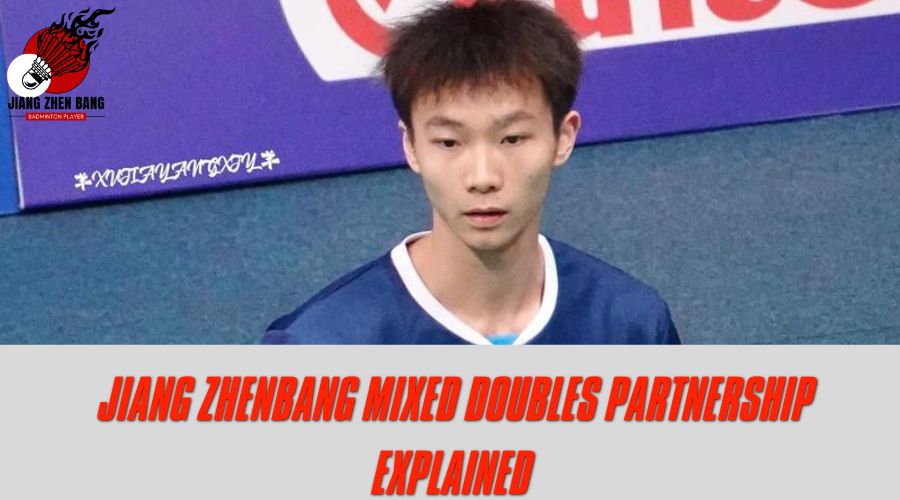
The Jiang Zhenbang mixed doubles partnership with Wei Yaxin is one of the most finely tuned pairings in modern badminton. More than raw chemistry, their success is built on tactical symmetry, emotional alignment, and a shared rhythm that allows two distinct playing identities to operate as one synchronized competitive system.
A pairing built on complementary instincts
The foundation of the Jiang Zhenbang mixed doubles partnership is not accidental. Mixed doubles is inherently asymmetric-one athlete commands the backcourt while the other orchestrates the net. But pairing players who “fit the mold” is not enough; the instincts must link.
Backcourt authority meets net intelligence
- Jiang’s strengths: reach, steep angles, tempo control, rotation speed
- Wei’s strengths: crisp net intercepts, early shuttle reading, compact defense
The result is a structural pairing where each amplifies the other’s strengths rather than duplicating them.
Natural spatial awareness
Some pairs need years to understand each other’s spacing. Jiang and Wei seemed to “feel” the geometry of each other’s movement from early in the partnership.
The communication blueprint – subtle, efficient, unspoken
Communication in mixed doubles is not about words; it is about cues.
The Jiang Zhenbang mixed doubles partnership is built on micro-signals so refined that even cameras rarely capture them.
The three major cues they use
- Toe-shift cue – Jiang signals incoming rotation with a slight weight shift.
- Net-blade angle – Wei adjusts her racket angle to signal which side she wants the next rally phase directed.
- Tempo tap – a soft tap of the shuttle before serve indicates the pace they want the rally to establish.
Why minimal communication works for them
Both athletes share a calm, analytical temperament. They don’t over-communicate; they synchronize.
Tactical division of labor – clearly defined yet fluid
Mixed doubles partnerships thrive on clarity. Jiang and Wei execute one of the clearest yet most flexible divisions of labor on the BWF Tour.
Jiang’s role – the architect
From the backcourt:
- He sequences attacks, rarely rushing to finish.
- He bends tempo, using half-smashes to reposition opponents.
- He resets the rally instead of forcing low-percentage winners.
He builds rallies like puzzles.
Wei’s role – the disruptor
From the front court:
- She intercepts early drives
- Cuts the shuttle downward to force lifts
- Applies micro-pressure that narrows opponents’ choices
She doesn’t overpower; she suffocates space.
The rotation engine – the heart of their system
Many mixed-doubles pairs lose points during rotation swaps, but the Jiang Zhenbang mixed doubles partnership excels because of how they rotate.
The “clockwise recovery” pattern
They prefer a clockwise transition where Jiang retreats diagonally while Wei cuts into the mid-net.
This creates:
- fewer collisions,
- faster re-formation,
- cleaner attack re-entries.
A built-in fallback plan
If spacing breaks, they default to a defensive V-shape-Jiang wide, Wei slightly behind the tape-buying precious milliseconds to reset.
Psychological compatibility – calm plus calm
Badminton partnerships often rely on one aggressive personality and one stabilizer. Jiang and Wei break that rule.
Double-quiet, double-strong
Both athletes are emotionally cool. Their rallies rarely spiral into panic or frustration.
This emotional mirroring creates:
- low-variance play,
- fewer momentum collapses,
- sustained consistency across long tournaments.
Their shared mindset
They treat mistakes as data, not drama. That is rare in mixed doubles.
How they handle pressure moments
Championship pairs are defined by what happens at 18-18, not at 5-5.
Jiang under pressure
He slows the rally.
He prioritizes angles, not speed.
He removes chaos from the exchange.
Wei under pressure
She becomes even more aggressive at the net, not less.
She forces a weak reply so Jiang can launch the finishing blow.
This “calm + assertive” pairing is devastating in tight sets.
Breaking down their signature patterns of play
Analysts often identify three core patterns in the Jiang Zhenbang mixed doubles partnership.
Pattern 1 – Net squeeze → forced lift → steep finish
- Wei squeezes the front court
- Opponent lifts under pressure
- Jiang strikes with steep angles
Pattern 2 – Midcourt tease → cross drop → intercept
A Jiang cross-drop tempts a reply that Wei intercepts instantly.
Pattern 3 – Defense-to-offense two-shot conversion
They convert defensive blocks into attack in just two shots-an unusually fast transition.
Matchup advantages – why top pairs struggle against them
Some partnerships shine until they hit elite defenses. Jiang and Wei break elite defenses.
Their advantages against top-10 pairs
- Jiang’s angles disrupt flat Indonesian-style pairs
- Wei’s anticipation counters Korean speed patterns
- Their pace modulation frustrates Japanese rhythm-based systems
They don’t just match styles-they scramble them.
Growth areas and future potential
Even top pairs have ceilings to push.
What they can still refine
- Faster close-out decisions when leading
- Variability in serve-return sequences
- More proactive midcourt pressure in fast halls
Why their prime years are ahead
Both are young, healthy, improving, and emotionally stable-ideal for long-term success.
The Jiang Zhenbang mixed doubles partnership with Wei Yaxin thrives because it is built on more than talent. It is a system: technical, emotional, tactical, and psychological. Their calm synergy, layered attack patterns, and complementary strengths position them not only as current champions but as one of the defining mixed-doubles pairs of this badminton generation.
