
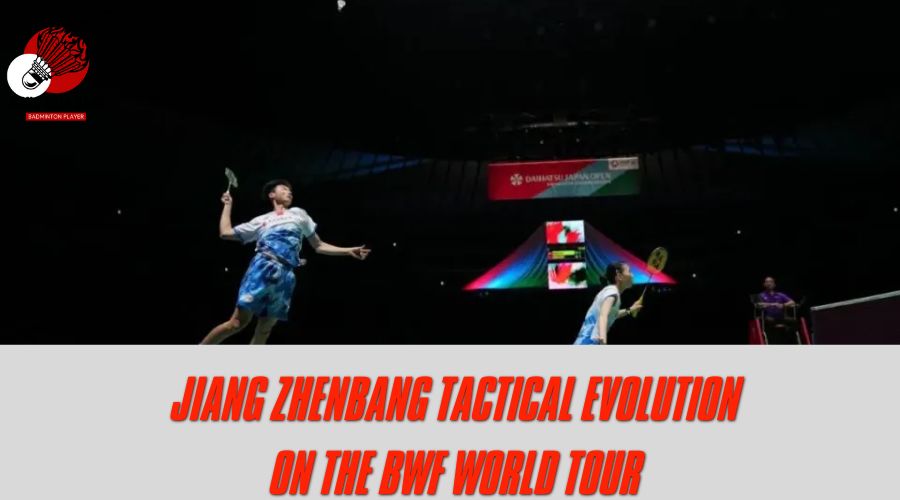
The story of Jiang Zhenbang tactical evolution is a study in discipline, adaptation and strategic maturity. As he progressed across the BWF World Tour, Jiang transformed from a raw backcourt hitter into a fully realized mixed-doubles architect capable of controlling tempo, shaping rallies, and dictating outcomes against the world’s best.
The Foundations – Power, Discipline and Rear-Court Identity
Every elite athlete starts with core strengths, and for Jiang, those strengths emerged early in his career. His height, discipline, and clean biomechanics positioned him naturally as a rear-court specialist. But in the early phases of Jiang Zhenbang tactical evolution, his game leaned heavily on raw power and physicality.
Early reliance on backcourt aggression
Like many emerging mixed-doubles players, Jiang first built his identity around his attacking capability. His steep smashes and fast transitions gave him immediate impact, but early versions of this style lacked tactical layering. Against top-tier pairs, power alone was rarely enough.
Learning to blend pace with precision
As Jiang gained international exposure, he began adjusting his shot selection – replacing brute-force smashes with controlled angles, delayed finishes, and disguised drops. This refinement marked his first major tactical leap.
Evolving Through Partnership – Jiang & Wei’s Strategic Growth
Mixed doubles exposes weaknesses faster than any other discipline, and early experiences on tour accelerated Jiang’s evolution. Playing alongside Wei Yaxin required him to sharpen not only technical execution, but also rhythm, communication, and tactical awareness.
Understanding tempo control
One of the defining elements of Jiang Zhenbang tactical evolution is how he learned to manipulate tempo. Instead of playing at one consistent speed, Jiang developed an ability to accelerate, stall, and redirect momentum depending on the opponent’s structure.
Synchronizing movement systems
Rear-court play is not just about hitting; it is about rotating with the front player. Jiang grew adept at reading Wei’s movements, timing his entries, and creating space for her interceptions. Their synergy enhanced both players’ strengths.
Tactical Intelligence in Rally Construction
As Jiang matured, he became not just a hitter – but a constructor. His rallies began to show intentional sequencing.
Multi-phase rally planning
Instead of seeking quick points, Jiang started building rallies in phases:
- Phase 1: Establish rhythm with probing shots
- Phase 2: Create openings through angle changes
- Phase 3: Strike decisively once the defense collapses
This compositional approach is a hallmark of elite tacticians.
Improved defensive resets
Early in his career, Jiang relied primarily on athletic recovery, but by 2024 he introduced structured resets – using soft blocks, neutral lifts, and controlled spacing to regain stability and re-enter the rally strategically.
Decision-Making Under Pressure – The Leap From Good to Elite
The biggest tactical strides in elite badminton occur under stress. Jiang’s transformation in high-stakes matches illustrates his maturity.
Choosing the right moment to attack
Early-career Jiang attacked too early; elite Jiang attacks at the perfect moment. Timing became one of his most dangerous weapons.
Mental clarity in long rallies
At the 2023 World Championships and 2024 Singapore Open, he demonstrated exceptional patience in extended exchanges – absorbing pressure, forcing errors, and waiting for calculated openings.
The Integration of Data, Analysis & Modern Coaching
Today’s champions evolve through data-driven guidance.
Jiang’s improvements in placement accuracy, return quality, and rotational efficiency suggest consistent collaboration with analysts and coaches.
Enhanced shot selection patterns
Statistically, his shift toward using more:
- cross-court drops,
- two-phase smashes,
- deceptive half-smashes,
reflects deliberate tactical structuring.
Opponent-specific preparation
By 2025, Jiang’s matches exhibit clear tactical adaptation based on opponent tendencies – targeting weaker rotations, exploiting slow transitions, and forcing awkward backhands.
A Modern Mixed-Doubles Architect – Not Just a Power Player
The most important shift in Jiang Zhenbang tactical evolution is conceptual:
He moved from relying on firepower to designing points.
He now embodies the modern mixed-doubles archetype:
- tactically balanced,
- emotionally steady,
- capable of switching between aggression and control,
- and deeply synchronized with his partner.
What Jiang’s Evolution Means for His Future
This evolution – from raw attacker to complete strategist – positions Jiang not only as a world-class athlete today but as a long-term force on the BWF Tour.
If early Jiang was defined by power, present Jiang is defined by purpose.
And future Jiang may be defined by mastery.
His trajectory suggests that his most complex, controlled, and dangerous badminton is still ahead.
